Travel From Your Kitchen: Best Lemon Macarons Recipe in the World- Straight from Paris! Includes 11 Tips from a Professional French Pastry Chef!
Travel From Your Kitchen: Best Lemon Macarons Recipe in the World- Straight from Paris! Includes 11 Tips from a Professional French Pastry Chef!
Last updated: . Egg-storage guidance and recipe explanations were updated; the original Paris class memories, ingredient quantities and cooking steps are preserved.
First published April 26, 2020. The lockdown comments and Paris class memories belong to that time. The original class ingredient quantities and cooking steps are preserved below, with current egg-storage and handling corrections clearly noted.
Paris Lemon Macaron Recipe
By Les Secrets Gourmands De Noemie
Welcome to my Travel From Your Kitchen Series! As we are all enjoying the COVID-19 lockdown at the moment, I wanted to share ways to travel exotically through food. Hopefully, I’m not the only one eating all my lockdown feelings over here. 🙂
Of all the places we want to go back to, Paris holds one of the top spots every time. When it comes to food, it always holds #1!
Paris is replete with amazing food and even more amazing desserts. Every corner has a boulangerie with pastries that could be classified as works of fine art. It’s the city to get fat in and enjoy every last bite!
I took TWO macaron classes in Paris and loved them both. Macarons are often made without wheat flour, but ingredients and cross-contact vary, so check labels and ask about preparation if you need to avoid gluten. Lemon macarons are the perfect mix of sweet and tart, chewy and crunchy. At least when done right!
*Disclaimer: This post may contain affiliate links. Opinions shared are my own, and I only endorse products I support. By clicking on any of the links below, I may get a small commission if you purchase at absolutely no additional charge to you. I appreciate your support.*
They are not easy to make, but you can do it! Take some self-isolation time to perfect your recipe. All parts of this recipe are delicious, so enjoy eating the fails too. 🙂 Enjoy those experiments once they are fully cooked; do not taste raw batter or undercooked egg filling.
I loved my class with Noemie. For current offerings, see Noemie’s website.
Current egg-handling note: Keep eggs and egg mixtures refrigerated at 40°F (4°C) or below. The FDA egg-safety guidance says to cook egg dishes to 160°F (71°C), checked with a food thermometer, and to use pasteurized eggs or egg products when eggs will remain raw or undercooked. For the lemon filling, check temperature rather than relying only on thickening. The original shell-baking time and syrup temperature below do not, by themselves, establish the final food’s safety. Refrigerate the cooked filling promptly; do not leave egg-containing food out longer than two hours (one hour above 90°F/32°C). The egg-white storage correction beside the ingredients supersedes my original one-week advice.
11 Tips From My Paris Class
In this class recipe, we used the same shell mixture with different food colors. Other macaron recipes can use different methods, nuts and flavorings; shells are not universally identical. See King Arthur Baking’s French-method macarons and Italian-meringue macarons for examples of different methods.
It’s essential to measure out your ingredients! True baking enthusiasts don’t use measuring cups but weigh ingredients for more accuracy. I use a little travel scale found here:
You can make your lemon filling ahead of time and store it in the fridge. I’d recommend making, cooling it completely in the fridge, and then storing it in the piping bag.
I always double the recipes. I figure if I’m going to make the effort, I might as well get double the result! This does make it more difficult in the process, so start with a single recipe first.
The warmer the batter for the macarons gets and closer to the end of the piping bag, the airier it will get. This means cookies that don’t look as good. Refrigerate the batter in between batches, if possible.
Macarons taste better with time, so they MUST sit in the fridge for at least 4 hours before eating. It’s even better if they are frozen and thawed again. Otherwise, you’ll have crumby cookies and not the soft, chewy macaron you want.
You need to make a template for your cooking. To do this:
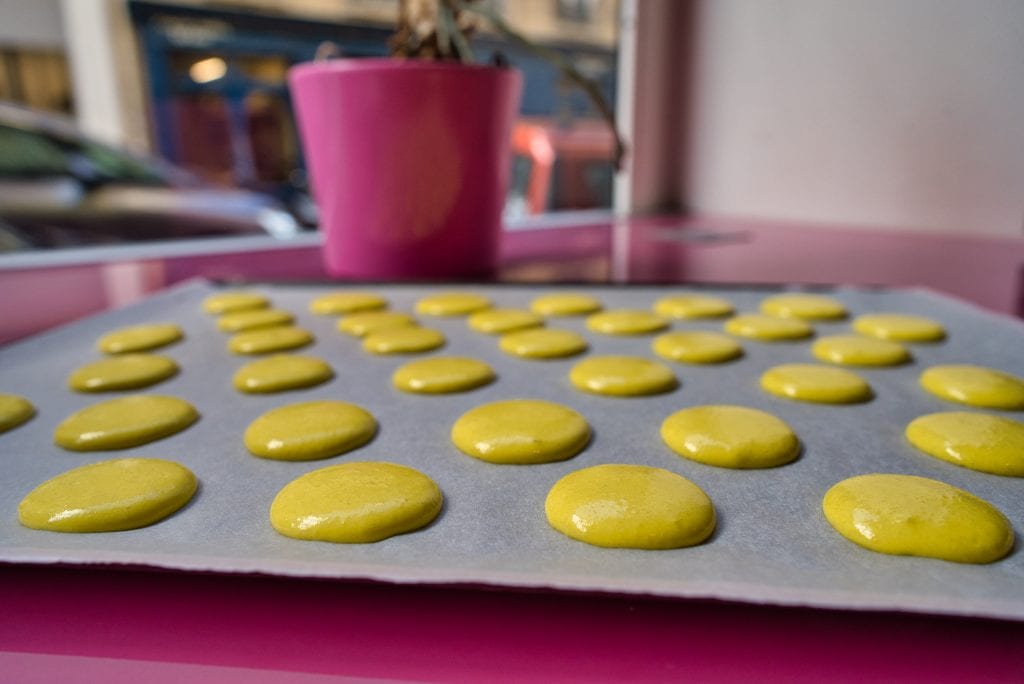
Find heavy card stock in the size of your baking pan. Use your #8 tip and trace cookie outlines or about 3 cm diameter circles. Offset cookies on the template, and you should end up with about 36 circles, but this can vary.
Put this template under parchment paper on your baking tray and pipe your cookies onto them. REMEMBER to remove this template BEFORE putting it in the oven!
I taped two pages of card stock together in a pinch, and it worked fine! I had to buy a cheap compass at a French grocery store to get this done since I didn’t have the right size tip. It’s a bit tricky, but you’ll get it. It helps a ton when piping our cookies!!
When piping your batter, you need to stay perfectly perpendicular to the template and not lift up in between circles. Instead, release the pressure of the top hand and quickly move over to the next circle. See my video to understand better.
Your oven matters! Noemie told us in class to avoid a gas oven because of moisture. That was her advice for these cookies, rather than a rule for every macaron recipe or oven. If it’s all you’ve got, just try your best, following your oven’s instructions!
For this class recipe, the advice was to use more than one tray with convection and one tray otherwise. Check your own oven’s manual for its fan settings and tray guidance; being a European oven does not establish which functions it has.
The class texture tip was to use a small cardboard box rather than an air-tight container to avoid sogginess. Use a clean, food-safe container and keep the egg-based filling refrigerated; texture preferences do not replace the cold-storage and handling guidance above.
Macaron Shells
Ingredients
150 g Almond Flour (Meal)
150 g Icing Sugar (Powdered Sugar in the USA)
50 g Egg Whites *
15 g Granulated Sugar
50 g Water
150 g Granulated Sugar
50 g Egg White*
Food coloring ** (Optional)
*Egg-white storage correction: My original class notes suggested separating the whites a day ahead and keeping them covered in the fridge for up to a week. Follow the current FoodSafety.gov cold-storage chart instead: raw separated egg whites and yolks have a refrigerated limit of 2–4 days at 40°F (4°C) or below. Any advance separation or “aging” must stay refrigerated, never overnight on the counter. Whites can also be frozen in the measured portions used here.
**Food coloring needs to be either powdered or gel. NOT liquid.
Equipment Needed
Candy Thermometer
Mixer or Hand Mixer
Whisk
Saucepan
Various mixing bowl
Scale
Piping Bags (at least two)
Piping Tips: #6 (6 mm diameter) for the filling and #8 (8 mm diameter) for the batter
Hand-made Template for Cookies
Parchment Paper
Directions
Preheat oven to 150 degrees Celsius or 300 degrees F. Set out your trays with your template and pre-cut parchment paper to fit within the lips of your tray.
Measure out all of your ingredients in separate bowls or containers and set aside.
Sift together almond flour and icing sugar into a large bowl.
In a small saucepan, combine water and 150g amount of sugar. Turn to medium to high heat and stir. Measure the temperature with a candy thermometer and get it to 112 degrees Celsius.
While the syrup is heating, get your first batch of egg whites (50g) and half of your 15g of sugar into your mixer (or big bowl and hang mixer). Mix on low until many small bubbles form. Add the remaining half of the 15g sugar and increase speed until soft, white peaks form. Don’t overbeat! If the syrup isn’t ready, turn off the mixer.
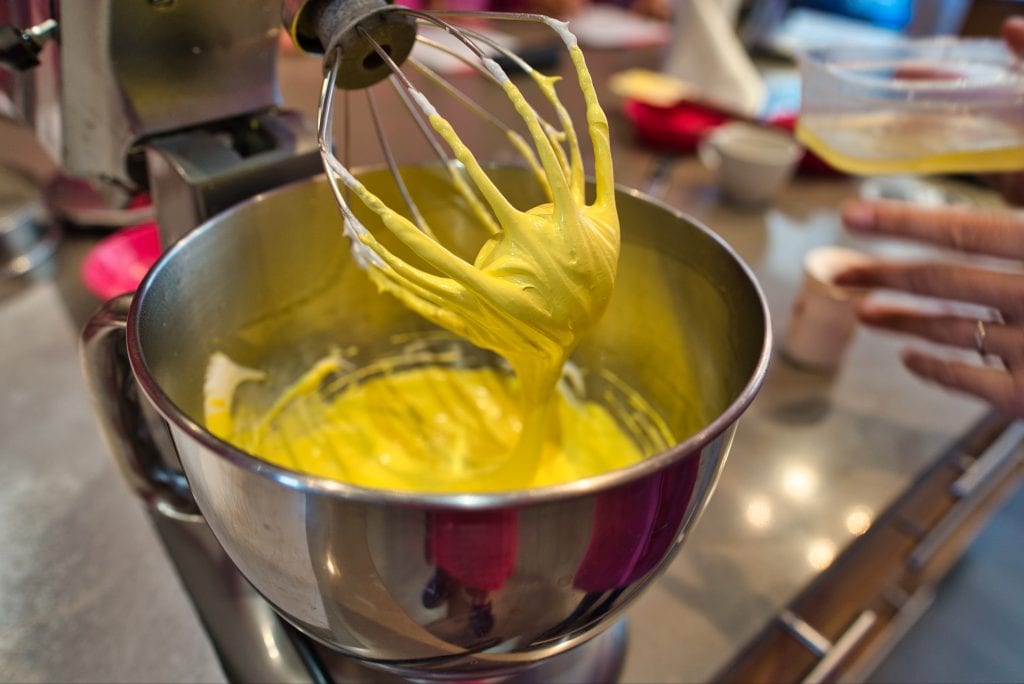
When the syrup is ready at 112 degrees, pour slowly over egg white peaks with low speed on your mixer. Increase speed when all syrup is combined and mix until cooled (when you can hold your hand to the side of the bowl.
Add food coloring and the second 50g of egg whites. Mix very briefly until just combined, about 5 seconds.
Turn off the mixer and remove it. Mix in by hand the almond mixture or pour in at once into the mixer and mix until combined, briefly. The meringue should be smooth and glossy.
Get your #8 piping tip into your piping bag, twist near the tip, and put it into a tall glass or container. Fold the plastic over the sides of the container to fill it with batter.
Spoon batter into a piping bag. Twist at the top and hold the top with one hand and tip with the other.
Pipe batter onto parchment paper following circle templates. Remove the template and use it on the next tray. Be sure to remove it before baking! (Although I forgot at least twice, and it was OK).
Bake tray(s) for 14 minutes. I always followed this and DID NOT open the oven to check!
Macaron cookies are done when you touch them, and they don’t wiggle. See my video tutorial!
Remove and let cool for a few minutes before sliding off the parchment paper and letting it cool completely.
When totally cool (within an hour), peel off the parchment paper and line up similar-sized circles side-by-side.
Pipe on the filling (a dollop about the size of a quarter) and gently wiggle the two cookies together, smooshing out the filling to the ends.
Pack up on their sides and get into the fridge or freezer.
Store for at least 4 hours, and then ENJOY! You’ve tasted the best of Paris, in my opinion!
Lemon Filling
Note: This is the same as the filling for a lemon tart and is absolutely addictively delicious. You SHOULD NOT suck the filling directly from the piping bag into your mouth. I mean, only the weak steep to such measures….
Ingredients
Zest of 1 Lemon
Juice of 1 Lemon
2 Eggs
70 g Granulated Sugar
80 g Unsalted Butter*, cut into even, small cubes
1/2 Gelatin Leaf**
*This class recipe calls for unsalted butter with at least 82% fat. It took me a long time to sort out the butter choice when making these macarons! My original note overstated the case against salted butter and generalized about availability in Europe. Unsalted butter lets you control the added salt; salted butter does not universally ruin baking. King Arthur Baking explains the differences in its butter-for-baking guide. Keep the specified butter and quantity for this recipe.
**Gelatin leaf is super cool and you need to soak it in cold water before you get started (at least 5 minutes). However, if you don’t have this, use 1 gram of gelatin powder.
Directions
Soak the gelatin, if needed, and zest and juice your lemon.
In a bowl, add sugar and eggs. Stir to combine. Add zest and lemon juice.
In a saucepan, bring water (about 2-3 inches deep) to a boil and place bowl on top (creating a double boiler). Keep at medium heat.
Whisk egg/lemon mixture constantly. Eventually, it will thicken. When it does, remove from stove.
Keep whisking your cream and add gelatin (without water). Stir to dissolve the gelatin.
When cream is cooled (you can hold your hand to the side of the bowl), add cubed butter. Stir until butter is melted and combined.
Cool in fridge or freezer completely. Add to piping bag (with tip already inserted and twisted to prevent leakage).
Pipe onto baked cookies and enjoy! Feel free to eat the rest at your leisure… or suck right from the piping bag.
Tag me in your macaron creations! I would love to see them!
















 Facebook
 Pinterest
 Youtube
4 Comments